


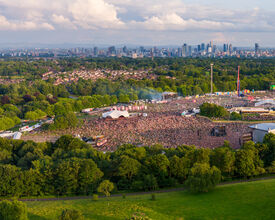
A forthcoming paper argues degrowth belongs on the table for mega festivals. The more useful question for organisers is what happens when capacity becomes a regulated number?
A paper due in the journal Event Management argues that the biggest festivals cannot reduce their environmental impact while they keep growing, and that licensing authorities should be willing to consider a ceiling on audience numbers, including a lower one than the licence currently allows. It is written by three UK-based academics, among them independent researcher Adrian Bossey and Mike Duignan, who also edits the journal.
As an argument, it is not new. Degrowth has been circulating in tourism and event studies for years, usually at a safe conceptual distance from anyone who has to file a permit application. What makes it worth a look now is the venue it is aimed at: not organisers, not sponsors, but the authority that signs the licence.
Because on the continent, that authority has already been handed the instrument. It just didn't arrive labelled as climate policy.
The arithmetic that makes capacity the obvious lever
The case for capping rests on a simple structural point. Almost everything the sector has done on sustainability over the past fifteen years improves emissions per head. Audience numbers, meanwhile, have gone up. If the per-head curve falls more slowly than the attendance curve rises, total impact grows, and every efficiency gain is spent on growth rather than banked.
The numbers to argue with are reasonably solid. A Greener Future's carbon footprint analysis of European and UK festivals puts the average at around 11 kg CO₂e per person per day. It also punctures a statistic the industry has leaned on for a long time: audience travel is usually quoted as 80% or more of a festival's footprint, but under fuller Scope 3 accounting, AGF found it averages closer to 41%. Travel as a whole - audience, artists, production, traders, suppliers - comes to roughly 58%. Food and drink account for about a third.
Two things follow, and they cut in opposite directions.
The first supports the capping argument. If roughly 11 kg per person per day is the operating reality, then attendance is not one variable among many. It is the multiplier on all of them. Waste works the same way: AGF's 2024 data puts average waste at 0.8 kg per person per day, rising to 1.4 kg at camping festivals against 0.5 kg at non-camping ones.
The second undercuts it. The averages hide enormous spread; audience travel has been measured anywhere from under a fifth to well over four-fifths of a footprint depending on scale, location and catchment. A cap applied to the headcount of an event whose audience arrives by train from 40 km away does very little. The same cap applied to a destination festival selling half its tickets abroad does a great deal. Headcount is a crude proxy for the thing that actually emits, which is distance travelled and how.
There is also a scale inversion worth knowing about, because it complicates the "mega festivals are the problem" framing: for festivals below 25,000 daily capacity, AGF found wider travel - production, traders, artists - rises to around 70% of emissions. Small does not automatically mean light.
Capacity is already a regulated number in the Netherlands
Here is the part the academic debate tends to miss. In several European jurisdictions, the permitted capacity figure has quietly become the central regulated quantity, arrived at through nature and nuisance law rather than carbon policy.
The Dutch nitrogen regime is the clearest case. Since the Council of State struck down the PAS programme in May 2019, an event that may cause a significant effect on an overloaded Natura 2000 site needs a nature permit, assessed via an AERIUS deposition calculation - and the threshold at which the obligation bites is extremely low. Courts have added two refinements that matter enormously in practice. Repeated events at the same site within a year can be assessed together as a single project. And the assessment has to be based on the permit's maximum use, not the organiser's expected use.
Read that second point as an organiser rather than a lawyer. It means the capacity number on your licence is not an administrative formality describing the busiest plausible Saturday. It is the figure the ecological assessment is run against. Ask for headroom, and you are asking for a larger environmental footprint to be assessed, approved and defended in any appeal. The incentive runs directly towards requesting less.
Since the Omgevingswet took effect, the nitrogen assessment is no longer automatically included in the event permit application, which places the burden on organisers to arrange it themselves and in good time. Festivals have lost permits over this. Nature permits for events in the Groene Ster near Leeuwarden were annulled in court in 2021; an island festival on Terschelling foundered on the same question.
Municipal policy points the same way through a different door. Amsterdam allocates scarce event slots through a calendar: events from 1,501 visitors upward must register, and from 3,001 upward the scarcity is distributed city-wide, with an advisory committee weighing expected visitor numbers alongside accessibility, quality and connection to the city or neighbourhood. The city reserves the ability to adjust visitor numbers up or down on public order and safety grounds. Location profiles set recovery periods between events so the ground can recover. In the UK, Boomtown's 2018 application to raise its capacity to 80,000 was refused, reportedly over local concerns about pressure on the transport network - a capacity cap enforced on congestion grounds that happens to be an emissions cap as well.
Even voluntary restraint exists. Glastonbury held back a few thousand tickets against its 210,000 licence in 2025 to ease crowding, and runs fallow years to let the land recover.
None of this was designed as climate policy. The effect is the same.
Source: IQ Magazine, Photo: iStockPhoto 2223198860