


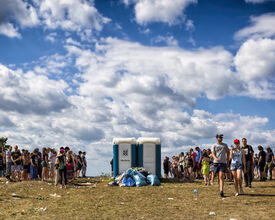
Nobody plans the toilets, and everybody queues for them. Of all the things you'll budget for and obsess over, the toilets get treated as plumbing, a facilities box the venue ticks off, somebody else's department.
Yet they're one of the very few parts of your event you can actually calculate in advance, down to the minute. Get the sum wrong and no amount of production budget will save you: the lasting memory of your event becomes the twenty minutes a guest spent in a corridor, crossing their legs.
The mistake is thinking the question is "how many toilets does the building have?" It isn't. The question is when everyone needs them. Demand at an event doesn't arrive evenly; it spikes. At a seated show with a single interval, the entire room stands up and heads for the same doors at the same moment. That surge, not the headcount on the booking form, is what you have to design for.
So do the sum - it's exactly the kind of capacity calculation Kevin Van der Straeten works through in his book, EVENTPLANNER, and it's simpler than the topic deserves. Say you have 300 guests and you follow the common rule of thumb of one toilet per 75 people, that's four cubicles. A toilet visit takes roughly two and a half minutes, so in a fifteen-minute interval, each cubicle can serve about six people: four cubicles, twenty-four people, in the whole break. Now imagine even a third of the room needs to go in that window, a hundred people. Twenty-four make it. The other seventy-six are still in the queue when the lights go down and the second half begins. The provision wasn't wrong on paper. The timing broke it.
That's the flaw in every per-head rule: it quietly assumes demand is evenly distributed across the entire event. Spread thin, four toilets are fine. Concentrate that same demand into one hard interval, and they collapse. A venue happily rated for 500 at a free-flowing reception, where people drift to the loos all evening, can be a disaster for a 200-seat conference with one synchronised break. The headcount didn't change. The demand profile did.
The good news is that almost every lever is in your hands. You can hire extra units. You can lengthen the interval so the queue actually clears. You can stagger breaks so two halves of the room don't surge at once. Or you can reshape the programme so there's never a single moment when everyone stands up together. The length of your break isn't only a programming decision, it's a toilet decision, and the two should be made in the same conversation.
And the queues aren't equal, which is the part most planners never measure. Women's visits take longer than men's, so identical provision produces wildly unequal lines, one side of the corridor empty, the other backed up to the bar. Allocating more cubicles where the demand and the dwell time are highest, or going gender-neutral, fixes a problem you'd otherwise never even see in a spreadsheet.
None of this is only about comfort. A queue for the loo is time not spent at the bar, lost revenue, on top of a worse experience. A backed-up corridor outside the toilets is a crowd-flow problem in its own right. And placement matters as much as numbers: a unit sited badly or under-serviced can send odour drifting straight into the room next door, sour the atmosphere and have people talking about the smell instead of the speaker. There are firms that'll mask it, but the cheaper fix is thinking about it before the doors open.
Then there's the servicing nobody schedules. A cubicle that runs out of paper at minute forty, or isn't restocked across a long day, is a maths failure of a different kind. Plan the attendants, restocking, and accessible cubicles with the same seriousness as the rest.
Renting toilets isn't plumbing you can leave to someone else. They're a capacity calculation you can do on the back of an envelope, so do it.
Source: Photo: iStockPhoto 1163550441